
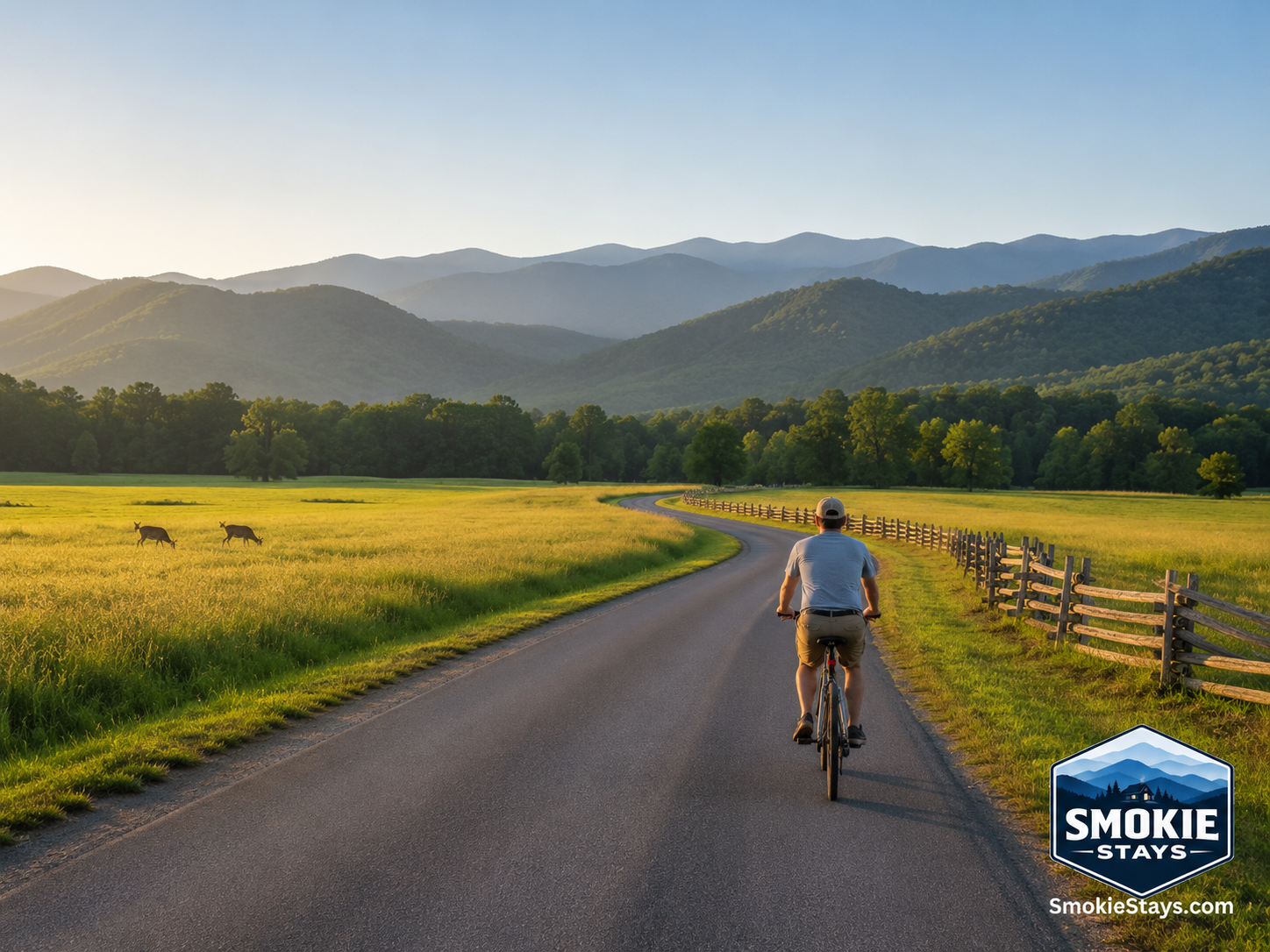
There's a version of Cades Cove that most visitors never get to experience. No idling engines, no slow-moving traffic jams, no waiting in a line of cars for a bear sighting down the road. Just the 11-mile loop, a mountain breeze, birdsong over the open meadows, and the kind of quiet that reminds you why people come to the Smokies in the first place.
That version exists every Wednesday from May through September — and if you're planning a trip to Great Smoky Mountains National Park this summer, building your schedule around one of these days is worth the effort.
What Are Cades Cove Vehicle-Free Wednesdays?
Each Wednesday from May 6 through September 30, 2026, the National Park Service closes the Cades Cove Loop Road entirely to motor vehicles from sunrise to sunset. The full 11-mile loop — normally a one-way scenic drive shared with hundreds of cars — becomes the exclusive domain of cyclists, walkers, and runners.
The program started as a pilot in 2020, growing out of decades of earlier vehicle-free mornings that had, ironically, created their own traffic problems. When the road reopened at 10 a.m. after those morning closures, the resulting rush made things worse. The all-day format solved that. It's been a regular part of the summer season ever since, drawing well over a thousand people on a typical Wednesday.
If you've driven the loop before and loved it, the vehicle-free version is a genuinely different experience. If you've driven it and found the stop-and-go frustrating, this is your answer.
What to Expect on the Loop
The Cades Cove Loop Road is paved and about 11 miles around the valley. The terrain is mostly rolling, with some moderate hills and long open stretches that get full sun. It's not a flat rail trail — plan accordingly.
Most people take two to four hours to complete the full loop, longer if they're stopping frequently to explore the historic structures, watch wildlife, or take photos. You don't have to do the whole thing: Sparks Lane and Hyatt Lane are two-way roads that cut across the middle of the cove, so you can shorten the route if needed.
Along the way, the loop passes some of the most well-preserved pioneer structures in the national park system. The John Oliver Cabin, near the loop entrance, is one of the oldest standing buildings in the cove — built in the 1820s. Three historic churches appear at different points along the route, including the Primitive Baptist Church, which still holds occasional services. At roughly the halfway point, the Cable Mill is the most visited stop: a working water-powered grist mill where demonstrations are still run, with freshly ground cornmeal available to take home.
Wildlife viewing in Cades Cove is some of the best in the entire park. White-tailed deer are nearly guaranteed in the open meadows. Black bears appear regularly, especially in the morning and evening hours. Wild turkeys, groundhogs, coyotes, and a wide variety of birds round out the list. On foot or on a bike, you're noticing far more than you would from a car window — smaller sounds, distant movement in the grass, the things that get filtered out when you're watching the road.
Bike Rentals and Rules
You don't need to bring your own bike. Rentals are available at the Cades Cove Campground Store, though they operate on a first-come, first-served basis and waits are common on vehicle-free days. If a bike rental matters to your trip, arrive early or plan to wait.
Current rates from the Cades Cove Trading Company are $15/hour for riders 16 and up, $10/hour for ages 15 and under. Helmets are included.
The rules for cyclists: only Class 1 and Class 2 e-bikes are permitted (no throttle-assist e-bikes, no scooters, no skateboards). All riders must follow the 20 mph speed limit posted on the loop. Tennessee law requires helmets for anyone under 16; they're strongly recommended for everyone.
Parking: The Part That Trips People Up
Vehicle-Free Wednesdays are popular, and the Cades Cove parking area fills up. The National Park Service is explicit about this: if parking is full when you arrive, you will be turned away and asked to return later. No exceptions, and roadside parking on Laurel Creek Road is not an option — it creates safety hazards and can damage the roadside ecosystem.
The counterintuitive advice from the park: avoid the morning rush by arriving in the afternoon. The early crowd clears, parking opens up, and the lighting for photography is actually better in the late afternoon anyway.
A valid parking tag is required for any vehicle parked more than 15 minutes inside the national park. Tags can be purchased online in advance, at the Great Smoky Mountains Welcome Center in Townsend, or at fee kiosks at the Townsend Wye or Cades Cove entrance.
What to Pack
The loop has hills, limited shade in several stretches, and zero cell service. Plan for a half day or longer, and bring everything you need:
- Water — more than you think. There's no easy way to resupply on the loop.
- Food or snacks. The visitor center is at the halfway point but not a full food stop.
- Sunscreen and a hat for the open meadow sections.
- A rain jacket. Smoky Mountain weather can shift quickly, even in summer.
- For cyclists: a basic repair kit — spare inner tube, pump, tire levers, multi-tool.
- Download an offline map before you leave. Cell service disappears once you're inside the cove.
The Cades Cove Visitor Center, located at the halfway point near the Cable Mill, has restrooms and basic information. There are also restrooms near the loop entrance.
Getting There
Cades Cove is located about 31 miles from Pigeon Forge. The most straightforward route takes you out Wears Valley Road (US-321) through Townsend, then turns onto Laurel Creek Road toward the loop entrance. From Gatlinburg, you can enter the park via Little River Road, which follows the river west through a beautiful stretch of old-growth forest before connecting to the Cades Cove area.
GPS note: cell service in the area can be spotty even before you reach the cove. Download your route or screenshot directions while you still have signal.
Making It Part of a Longer Trip
If you're building a full day around Cades Cove on a Wednesday, there's plenty of nearby territory worth exploring when parking is full or you're ready for a change of pace. The small town of Townsend is just a few miles from the loop entrance. The Great Smoky Mountains Heritage Center in Townsend is open Monday through Saturday, 10 a.m. to 5 p.m., and covers Appalachian and Cherokee history with hands-on exhibits. Tuckaleechee Caverns, open daily 10 a.m. to 6 p.m. through October, is one of the more impressive cave systems in the region.
For hikers, trails originating inside Cades Cove include the popular Abrams Falls Trail — a 5-mile round trip through old-growth forest to a 20-foot waterfall — and the shorter Cades Cove Nature Trail for families with younger kids.
If you're staying in the area for the week, Sevierville, Pigeon Forge, and Gatlinburg are all within reasonable driving distance and serve as easy base camps for a full itinerary around the park. We keep a small, hand-picked portfolio of cabins in the Smokies area — browse what's available for summer stays at smokiestays.com/cabins.
Information on Cades Cove Vehicle-Free Wednesdays is provided by the National Park Service. For the most current details on road conditions, parking, and program dates, visit the official Great Smoky Mountains National Park website at nps.gov/grsm.