
Most visitors to the Smoky Mountains drive through Townsend without stopping. They're headed to Cades Cove or using the Townsend entrance to avoid the Gatlinburg traffic, and the small town on the highway between Maryville and the park boundary reads as a pass-through rather than a destination. That's a navigational error worth correcting.
One mile from the Townsend entrance to Great Smoky Mountains National Park, on a 14-acre campus that most Gatlinburg and Pigeon Forge visitors never discover, is one of the most substantive cultural institutions in the entire Smokies region. The Great Smoky Mountains Heritage Center preserves 10,000 years of human history in the Tuckaleechee Cove area — from pre-Columbian Cherokee artifacts unearthed during a highway construction project to the 19th-century Appalachian structures that define the visual memory most people carry of this landscape. It runs a Grammy-winner concert series in an open-air amphitheater. It offers guided tours to Cades Cove. And it's open six days a week for less than the price of a Parkway T-shirt.
What Is the Great Smoky Mountains Heritage Center?
The Great Smoky Mountains Heritage Center is a private non-profit museum located in Townsend, Tennessee, near the city's entrance to Great Smoky Mountains National Park. Its mission is to preserve the heritage and culture of the inhabitants of the Great Smoky Mountains, including both the region's Native American inhabitants and the pioneers and residents of the region's Appalachian communities.
The center was established in 2006 following a remarkable discovery: during a Tennessee Department of Transportation project to widen Highway 321 through Townsend, construction crews unearthed a significant cache of Native American artifacts representing 5,000 years of continuous habitation in Tuckaleechee Cove. The artifacts found represent 5,000 years of Native American history in Tuckaleechee Cove and are invaluable in telling the story of the region's past. The Tennessee Department of Transportation and the Federal Highway Administration partnered with local organizations to develop the Heritage Center as a public repository and interpretive facility for those artifacts and the broader cultural history of the region.
The Center maintains two indoor galleries and has a third gallery under construction, focusing on the history and diversity of culture around Townsend and Tuckaleechee Cove. The Heritage Center boasts over 17,000 square feet of indoor and outdoor exhibits.
Address: 123 Cromwell Drive, Townsend, TN 37882 Phone: (865) 448-0044 Website: gsmheritagecenter.org
The Cherokee Native American Collection
The foundation of the Heritage Center's indoor programming is its Cherokee Native American collection — the artifacts recovered during the Townsend archaeology project alongside material from broader regional collections that document the deep human history of the Smokies before European contact.
Ancient pottery discovered in Townsend, stone tools, and historic and prehistoric artifacts dating back over 10,000 years form the core of this collection. The gallery covers the arc of pre-Columbian habitation in the region — the Archaic period hunter-gatherers who moved through the valleys 10,000 years ago, the woodland cultures that developed settled agriculture and ceramic traditions, the Cherokee Nation that was the dominant civilization of these mountains when European contact began in the 1500s, and the catastrophic displacement of the 19th century that separated the Eastern Band of Cherokee from the land the Heritage Center now documents.
The Cherokee gallery is genuinely rare in the Smokies tourism context — most visitors experience Cherokee history primarily through the commercial strip of the Eastern Band's reservation in Cherokee, North Carolina, which is worth visiting on its own terms but is a different kind of experience than a museum built around archaeological evidence. The artifacts at the Heritage Center speak in a different register: these are objects made and used by specific people in this specific valley, recovered from the ground their descendants were forced to leave.
The Historic Appalachian Village
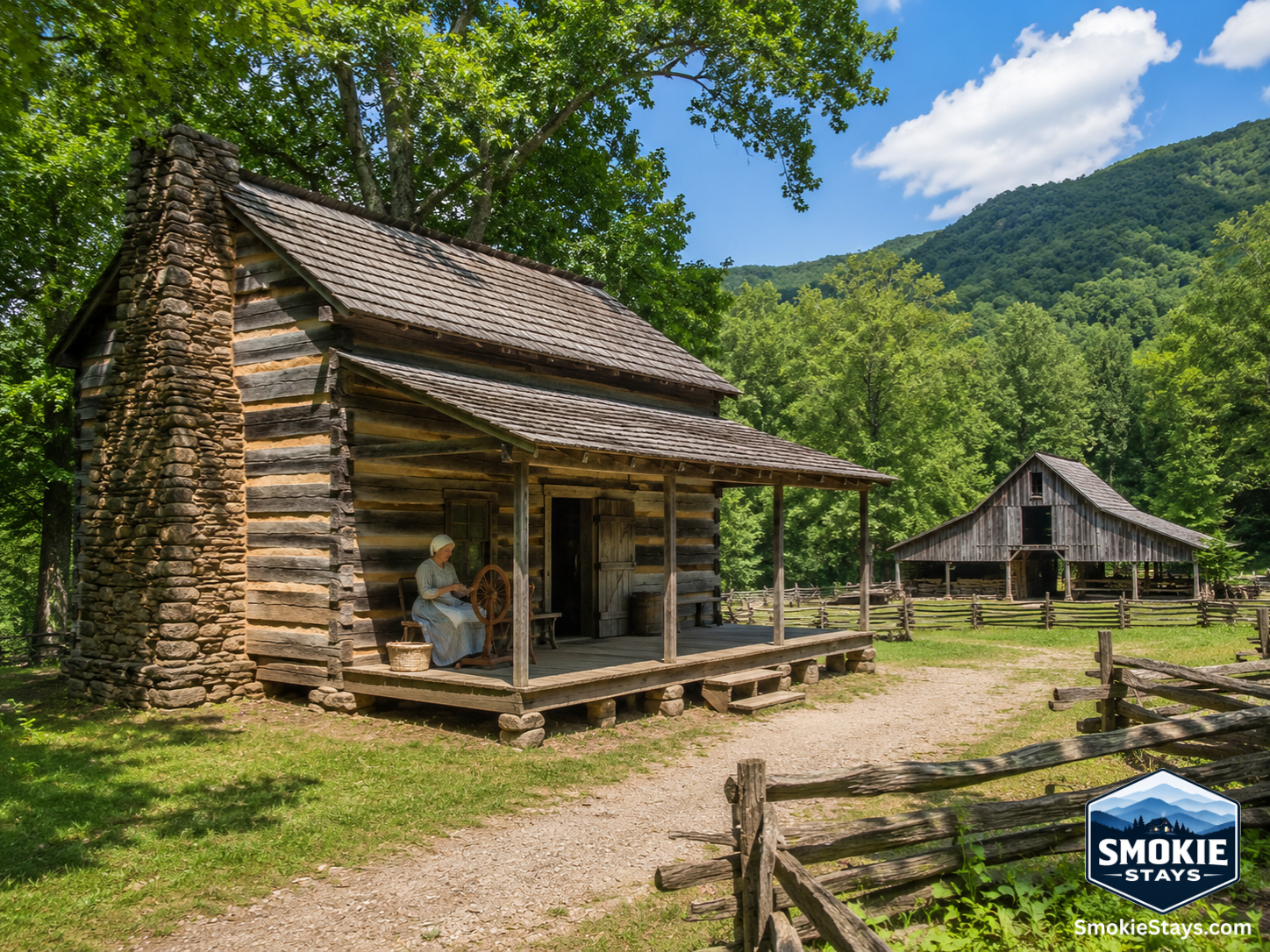
The Heritage Center has saved and relocated 18 authentic structures of the region, some dating back to the early 1800s. Each building in the historic village has a unique story, and the structures have been furnished according to the period in which they were built.
The outdoor historic village is the component that most surprises first-time visitors — the scale and authenticity of 18 relocated structures across the Heritage Center's 14-acre campus creates a walkable landscape that doesn't feel like a museum exhibit so much as a preserved corner of the 19th century that somehow ended up adjacent to a national park.
The structures include a log cabin, two cantilever barns, an AME Zion chapel, a logging town "setoff" house, a sawmill, and a still once operated by a local moonshiner. The cantilever barns are the architectural element most photographers specifically seek — a structural form specific to the East Tennessee region, where the upper floor of the barn cantilevers out beyond the lower foundation in a way that provides shade for the working area below while maximizing hay storage above. These are not reproductions. They were built by hand by specific families whose names are documented, and they carry the marks of the people who built and used them.
Live historic interpreters staff the village on most operating days — people in period clothing performing demonstrations of the specific skills and trades that daily life in a 19th-century Appalachian community required: spinning, weaving, blacksmithing, cooking over open hearths. The demonstration format gives the village an educational depth that static displays don't produce — watching someone card raw wool into yarn while explaining which sheep breeds were kept in Tuckaleechee Cove before the park acquired the land connects visitors to a specific place and time rather than a generalized version of Appalachian history.
The Indoor Galleries
The two active indoor galleries cover the full range of the region's cultural history across distinct thematic focuses.
The Native American gallery documents the archaeological evidence and cultural context of pre-Columbian and early contact-era Cherokee life in the Tuckaleechee Cove area — artifacts displayed in the context of the broader Cherokee civilization of the southern Appalachians, with interpretation that contextualizes the specific Townsend finds within the larger story of Indigenous habitation from the end of the last ice age forward.
The pioneer and settlement gallery covers the European and Scots-Irish immigration into the mountains from the late 18th century through the establishment of the national park in 1934 — the specific families who farmed and logged and built the structures now preserved in the outdoor village, the modes of transportation that connected the mountain communities to the broader economy, and the complex relationship between the incoming settlers and the Cherokee communities who were simultaneously being displaced from the same landscape.
A third gallery is currently under construction — which will expand the Heritage Center's interpretive capacity and cover aspects of the region's history not yet addressed in the current exhibits. Check the official website for updates on the third gallery's opening as construction progresses.
The Cades Cove Guided Tour
The Great Smoky Mountains Heritage Center offers fully guided bus tours for individuals and groups to Cades Cove. While traveling in a comfortable passenger vehicle with an experienced and friendly guide, you'll learn all about the history, personal stories, and natural resources that make the Smoky Mountains so unique.
This is one of the most underutilized visitor services in the Smokies region — a guided interpretation of Cades Cove from people who know the specific histories of the families that lived there, the specific structures along the loop road, and the specific events that shaped the community before the park acquired the land. The standard self-guided Cades Cove experience is excellent. The guided tour version is considerably richer.
Contact the Heritage Center directly at (865) 448-0044 or through the official website to arrange guided tour reservations — availability is limited and booking ahead is recommended.
The Summer Concert Series
You'll see Grammy winners, Hall of Famers, and local favorites during the annual Friday night concert series. The Heritage Center's summer concert series runs in a 350-seat, open-air amphitheater on the 14-acre campus — one of the more distinctive live music venues in the Smokies region, with the mountain backdrop and the historic village as the setting for performances that run from traditional Appalachian music through bluegrass, country, and occasionally the kind of crossover bookings that reflect the Heritage Center's commitment to being a living cultural institution rather than a static historical display.
Weekend concerts draw attendees from across the region. The Eagles tribute review mentioned in recent visitor accounts is representative of the eclectic booking approach — the Heritage Center is not limiting itself to period-appropriate music in the amphitheater, and the result is a concert series that serves the broader regional audience rather than exclusively the museum visitor.
The annual concert schedule is posted on the official Heritage Center website and Facebook page at facebook.com/GSMHC. Admission to concerts varies by event — some are included with museum admission, others are separately ticketed.
Festivals and Special Events
The Heritage Center hosts concerts and other special events on its 14-acre campus or in its 350-seat, open-air amphitheater throughout the year.
Annual events at the Heritage Center include craft and cultural festivals built around the specific traditions of the region — the Great Smoky Mountains Fiber Fair and the Tuckaleechee Pottery Festival are the recurring craft events that draw regional artisans and enthusiasts. The Fiber Fair specifically connects to the wool and weaving traditions documented in the historic village's spinning and weaving demonstrations — it's one of the stronger regional fiber arts events in East Tennessee.
The Heritage Center also periodically hosts living history events during which the outdoor village is fully staffed and programmed — every structure occupied by interpreters in period clothing, demonstrations running throughout the grounds, and the visitor experience closest to what the village can be at its fullest programming level. Check the official website for the 2026 event calendar.
Hours and Admission
Hours are Monday through Thursday 10 a.m. to 5 p.m., Friday 11 a.m. to 5 p.m., Saturday 10 a.m. to 5 p.m., and Sunday noon to 5 p.m. The Heritage Center is closed on certain holidays — verify current hours at gsmheritagecenter.org before your visit.
Admission pricing is modest compared to the major Pigeon Forge and Gatlinburg attractions — a deliberate reflection of the Heritage Center's non-profit educational mission. Current adult admission was in the $10–$15 range at the time of writing — confirm current pricing at the official website or by calling (865) 448-0044.
Admission tickets may be purchased online, by phone, or on a walk-up basis at the entrance. This is one of East Tennessee's premier facilities for non-traditional, hands-on learning, and the admission price reflects a different value proposition than a commercial theme park — you're funding a preservation institution, not a ride system.
Getting There: The Townsend Advantage
Townsend is located on US-321, approximately 30 miles from Pigeon Forge via Wears Valley Road and 24 miles from Gatlinburg via the Little River Road through the national park. The Heritage Center is at 123 Cromwell Drive — one mile from the park entrance on the west side of town, easily visible from the highway.
The drive to Townsend is worth noting as an experience in itself. Little River Road from Gatlinburg follows the river through some of the most beautiful old-growth corridor in the national park — a drive that produces wildlife sightings, scenic pull-offs, and a change of pace from the Parkway that rewards taking it slowly. Combining a Heritage Center visit with the Little River Road drive and a stop at the Townsend Wye swimming hole creates a full day away from the tourist corridor without requiring any significant logistical planning.
The Townsend Wye — the confluence of the Little River and Laurel Creek, a few minutes from the Heritage Center — is one of the most beloved swimming and picnicking spots in the entire Smokies area. On a warm day, it's the ideal end point to a Heritage Center morning.
Why This Is Worth Your Time
No venue in the Smokies provides a better glimpse into the human history and diverse cultures that have inhabited this beautiful region. That's a strong claim in a corridor saturated with attractions competing for the same tourist dollar. It holds up.
The Heritage Center occupies a specific position in the Smoky Mountains visitor landscape: it's the place that explains why the land you're visiting looks the way it does, who was here before the park was established, what they built and how they lived, and what was lost and what was preserved when the communities were displaced. Understanding that history doesn't diminish the natural beauty of the park — it adds a dimension to it that most visitors leave without.
For families homeschooling, for history enthusiasts, for visitors who have been to the Smokies multiple times and want to go deeper than the Parkway, and for anyone who has walked through Cades Cove and wondered who built those cabins and what their lives were like — this is the place to answer those questions.
Planning Your Visit
A morning at the Heritage Center pairs naturally with an afternoon at Cades Cove — the context the museum provides for the loop road's historic structures makes the cove visit significantly richer. The Heritage Center's guided Cades Cove tour combines both into a single organized experience.
If you're staying in a cabin in the Sevierville, Pigeon Forge, or Gatlinburg area, the Townsend corridor is accessible as a day trip that covers the Heritage Center, Little River Road, and the western park entrance — a genuinely different day from the standard Parkway itinerary.
We keep a small, hand-picked portfolio of cabins across the Smokies area — take a look at what's available at smokiestays.com/cabins.
The Great Smoky Mountains Heritage Center is located at 123 Cromwell Drive, Townsend, TN 37882. Open Monday–Saturday 10 a.m. to 5 p.m. (Friday from 11 a.m.) and Sunday noon to 5 p.m. For current admission pricing, the 2026 concert and event schedule, guided tour reservations, and the most current hours, visit gsmheritagecenter.org or call (865) 448-0044.